Wind turbine blade repair for the Australian fleet
Blades fail quietly. A hairline crack or a few millimetres of leading-edge erosion costs nothing today and a six-figure blade replacement in two years.
Blades take the full load of wind, rain, hail, dust, lightning, ultraviolet and bird strike, and they do it at tip speeds past 300 km/h. On an Australian site that means abrasive coastal and inland grit, intense summer ultraviolet and a high lightning count across the eastern seaboard. Damage is not a question of if, but when, and timely wind turbine blade repair is the single highest-return intervention in most operations and maintenance budgets. Caught early, nearly every defect is a repair. Left to run, the same defect becomes a replacement blade, a crane job and weeks of lost generation.
Wind Turbine Services matches owners and asset managers to independent blade crews who categorise the damage, choose the right access method and carry out the repair to the blade maker's procedure or an equivalent independent regime. The scope below covers what those providers deliver.
Laminate and structural composite repair
Most of a modern blade is glass or carbon-fibre composite over a balsa or foam core, bonded along the leading and trailing edges and stiffened by internal spar caps and shear webs. Structural composite repair restores that load path when it is broken by a crack, an impact or a manufacturing defect that has grown in service. The repair technique is chosen to match the original laminate.
Hand lay-up, vacuum bag and resin infusion
Hand lay-up is the workhorse for smaller laminate repairs: the damaged plies are ground back to a tapered scarf, fresh glass is laid in matching the original schedule, and the patch is wet out and consolidated. For larger or more critical repairs the crew moves to vacuum bagging, drawing the laminate down under vacuum to remove voids and improve fibre-to-resin ratio, or to resin infusion for the largest structural work where a dry preform is laid up and infused under controlled vacuum. Controlled heat cures the resin to spec. These are the same processes used to build the blade, applied in the field or the workshop.
Spar cap, shear web and root repair
The spar cap and shear web carry the bending load of the blade, and damage here is the most serious a blade can take. Spar-cap repair and shear-web repair are structural, engineered repairs that usually need a workshop, controlled conditions and sign-off against a repair drawing. Blade root repair, at the bolted connection to the hub, is equally critical because it carries every load the blade sees into the pitch bearing. Providers in our network handle these major structural repairs and coordinate any engineering assessment the repair drawing requires.
Cosmetic, FOD and surface repair
Not every defect is structural. Cosmetic repair addresses gelcoat chips, surface cracks, pinholes and worn paint that let water into the laminate if ignored. Foreign-object-damage (FOD) repair covers impact from hail, bird strike, debris or dropped tools, where the surface and outer plies are breached but the main structure is intact. Trailing-edge splits and tip damage fall here too. Catching surface defects early, and recoating with gelcoat or a protective topcoat, keeps water and ultraviolet out of the composite and stops a cosmetic problem from becoming a structural one. This work pairs naturally with scheduled wind turbine inspection, which finds the defects a repair crew then closes out.
Crack and delamination repair
Cracks and delamination are the defects that keep asset managers awake. A surface crack can be cosmetic or it can be the visible end of a growing structural fault. Blade delamination, where the composite plies separate internally, is often invisible from the outside and is found by tap testing, thermography or ultrasound during inspection. Both grow under cyclic load, and both are far cheaper to arrest early than to live with. Matched providers map the extent of the blade crack or delamination, grind out the damage, rebuild the laminate and verify the repair before the blade returns to service.
Aerodynamic upgrades
Blade crews do more than fix blade damage. Aerodynamic upgrades recover or add annual energy production on blades that are structurally sound. Vortex generators, small fins bonded to the suction side, re-energise the boundary layer and delay flow separation on the inboard section. Serrated trailing edges cut aerodynamic noise and can lift output where a site is noise-constrained. Gurney flaps, a small tab on the trailing edge, increase lift on the inboard blade. These add-ons are fitted by the same rope-access crews that handle repairs and often pay back inside a season on a well-chosen fleet.
Access methods: rope access, platform and blade pull-down
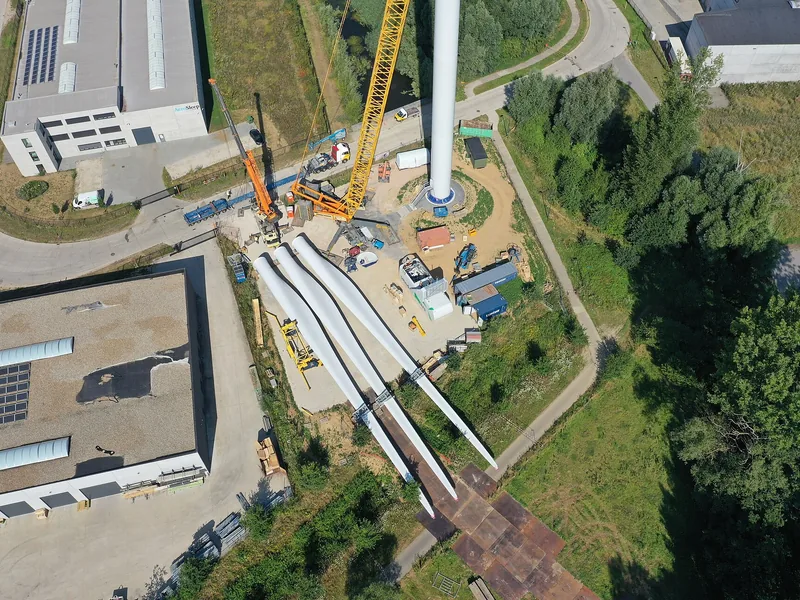
How a provider reaches the damage drives the cost and the timeline. Rope access, delivered by IRATA or SPRAT certified composite technicians, is the fastest and lowest-cost method for leading-edge, cosmetic, lightning and smaller laminate repairs, and crews can often mobilise within days. Suspended and spider platforms give a stable working deck for larger uptower repairs and better control of heat and vacuum. When a repair is too large, too structural or needs full workshop conditions, the blade comes off: a blade pull-down lowers the blade to the ground using a crane, the repair is completed in a controlled workshop, and the blade is reinstalled. Blade pull-down is coordinated with heavy-lift providers, and we match that scope through our main component exchange crane partners.
Matched to your blade type and turbine platform
Blade construction, repair procedures and approved materials differ by maker and model, so we match providers with real experience on your blades, whether your platform is Vestas, Siemens Gamesa or Nordex. Where blade damage is beyond economic repair, the same providers advise on blade replacement and on decommissioning and repowering. Coverage is organised by state so crews can reach your site: Victoria, South Australia and Tasmania, among others. For the two most common recurring jobs, see our dedicated pages on leading edge protection and lightning protection.
Wind Turbine Services is a sourcing and comparison service and does not perform maintenance itself. Enquiries are passed to independent service partners who contact you directly. There is no cost or obligation to owners and asset managers.
Frequently asked questions
What does wind turbine blade repair in Australia cover?
It spans laminate and structural composite repair, cosmetic and foreign-object-damage repair, crack and delamination repair, bond-line and spar-cap repair, root repair, aerodynamic upgrades and surface recoating. Work is delivered on-site by rope access or platform, or in a workshop after a blade pull-down. Providers in our network scope the repair against your blade type, damage category and turbine platform.
Who performs the work I am matched with?
Independent blade service firms, rope-access composite crews and specialist repair workshops. Wind Turbine Services is a sourcing service: we route your enquiry to vetted providers who hold IRATA or SPRAT rope-access tickets, GWO training and composite repair accreditation, cover your blade and turbine platform and can reach your state. They contact you directly.
Can blade damage be repaired uptower or does the blade come down?
Most leading-edge erosion, cosmetic damage, lightning strike repair and smaller laminate cracks are repaired uptower by rope access or from a suspended platform. Larger structural repairs to the spar cap, shear web, bond line or root, and repairs that need controlled heat and vacuum, are usually done in a workshop after a blade pull-down. The provider decides on-site versus workshop once the damage is categorised.
How much does wind turbine blade repair cost?
Cost depends on damage category, access method, blade length and whether the repair is uptower or workshop based. A cosmetic or leading-edge repair by rope access may run a few thousand dollars per blade, while a major structural repair or a blade pull-down with crane support runs into tens of thousands. Matched providers quote against your exact blade type, damage and site.
How fast can a crew mobilise for blade damage?
Rope-access crews can often mobilise within days for urgent delamination or storm damage, subject to weather and turbine shutdown. Tell us the make, model, blade type, damage description and state, and we match providers who can reach your site and respond at the pace your availability targets demand.